 Plan Your Trip
Chola Pass EBC Trek 19 Days
Trip Overview

Trek Region
Everest

Difficulty Level
Hard

Trek Starts at
Kathmandu

Transport
flight

Trek Ends at
Kathmandu

Total Trip Duration
19 Days

Max Elevation
5,545m
Trip Highlights
- Stand at the iconic Everest Base Camp (5,364m) and face the Khumbu Icefall
- Watch sunrise paint Everest golden from Kala Patthar (5,545m) — the ultimate Everest viewpoint
- Cross the thrilling Cho La Pass (5,420m) — a glaciated, high-altitude pass connecting two of the most beautiful valleys in the Khumbu
- Discover the magical Gokyo Lakes — a chain of six sacred turquoise glacial lakes
- Hike to Gokyo Ri (5,357m) for a jaw-dropping 360-degree view of four 8,000m peaks: Everest, Lhotse, Makalu, and Cho Oyu
- Walk beside the Ngozumpa Glacier — the longest glacier in Nepal
- Trek through the Sagarmatha National Park, a UNESCO World Heritage Site
- Visit the majestic Tengboche Monastery, the spiritual heart of the Khumbu
- Explore Namche Bazaar, the vibrant Sherpa capital of the Himalayas
- Immerse in authentic Sherpa culture and mountain hospitality in remote villages
Trip Summary
There is a version of the Everest region experience that goes beyond the classic Base Camp trail one that takes you across a glaciated high mountain pass, drops you into a valley of sacred turquoise lakes, and still delivers everything the Everest Base Camp trek is famous for. That is exactly what the Cho La Pass EBC Trek gives you.
This 19-day itinerary follows the well-loved Everest Base Camp route from Lukla through Namche Bazaar, Tengboche, Dingboche, Lobuche, and Gorakshep all the way to Everest Base Camp (5,364m) and the legendary sunrise at Kala Patthar (5,545m). Then, instead of simply retracing your steps, you cross the dramatic Cho La Pass (5,420m) into the Gokyo Valley, explore the breathtaking Gokyo Lakes, and summit Gokyo Ri (5,357m) for one of the most spectacular panoramas in the entire Himalayas.
The 19-day itinerary includes proper acclimatization, buffer days in Kathmandu for flight flexibility, and a relaxed pace that lets you genuinely experience and enjoy every part of this extraordinary route.
When To Visit
The Cho La Pass EBC Trek performs best in the two established trekking seasons when weather is stable, skies are clear, and the passes are safely accessible.
- Spring (March to May) is the most popular season across the Khumbu. The lower valleys are full of blooming rhododendrons, and temperatures at altitude are warming up after winter. This is also the Everest climbing season, meaning you will see expedition teams at Base Camp and on the Khumbu Icefall — an added spectacle for trekkers. March and the first half of April offer a good balance between pleasant weather and manageable crowds.
- Autumn (September to November) is widely considered the finest trekking season in Nepal. The monsoon has cleared the air, visibility is exceptional, and the light for photography is as good as it gets anywhere. October is peak month with full teahouse availability and the clearest mountain views. Early November is excellent with noticeably fewer trekkers.
- Winter (December to February) is possible but demanding. The Cho La Pass can become heavily iced or blocked by snow, making the crossing dangerous without proper cold-weather gear and an experienced guide. Some higher-altitude teahouses close during this period. Only for experienced cold-weather trekkers who understand the additional risks.
- Monsoon (June to August) is not recommended. The Cho La Pass section becomes particularly risky — wet, slippery, and prone to rockfall. Mountain views are obscured for days at a time, and the overall trekking experience is significantly diminished.
Itinerary
Welcome to Nepal. Our team meets you at Tribhuvan International Airport and transfers you to your hotel in Kathmandu. In the evening, your trekking guide sits down with you for a comprehensive pre-trek briefing covering the full route day by day, gear checks, permit requirements, altitude awareness, and emergency protocols. If your energy allows, a short wander through the busy, colorful lanes of Thamel gives you an instant feel for Nepal’s warmth and energy. Overnight in Kathmandu.
The journey begins with one of the most talked-about short flights in the world. The 35-minute mountain flight from Kathmandu to Tenzing-Hillary Airport in Lukla takes you between towering white peaks before landing on a short, sloping runway cut into the mountainside. The moment you step off and breathe the cold, clean air of the Khumbu, the excitement shifts into something very real.
From Lukla, the trail descends gently through pine and rhododendron forests alongside the rushing Dudh Koshi River. Small Sherpa settlements dot the route, yak trains pass with bells ringing, and the prayer flags above every bridge remind you that you are walking into a deeply sacred landscape. Phakding is a calm, welcoming village where you spend your first night on the trail. Walking time: 3–4 hours.
This is one of the great days of the entire trek. The trail to Namche is a sensory experience deep river gorges, swaying high suspension bridges strung with colorful prayer flags, dense forest corridors, and the constant thunder of the Dudh Koshi far below. At Monjo, you enter Sagarmatha National Park and complete the official checkpoint paperwork.
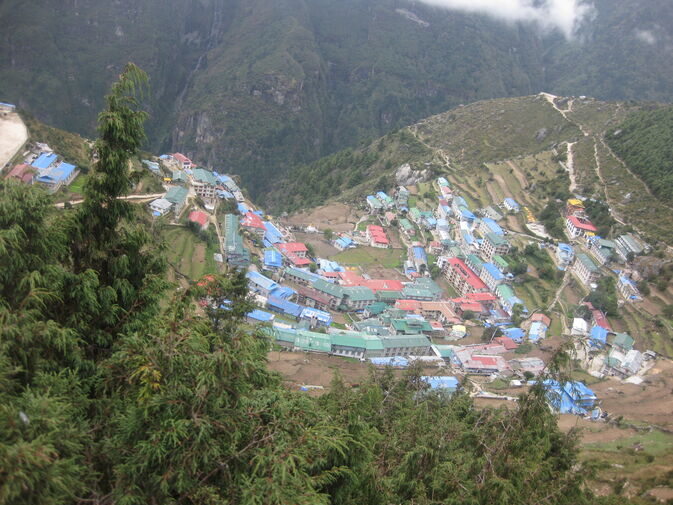
Beyond Monjo, the trail crosses the famous Hillary Suspension Bridge and then begins the long, relentless climb to Namche. It is steep, it is honest, and it earns you your first real view of Everest peeking above the ridgeline. Namche Bazaar appears suddenly, carved into a natural bowl in the mountain — a proper Himalayan town with bakeries, gear shops, restaurants, and an energy that immediately tells you this place is special. Walking time: 5–6 hours.
Spending a full rest day at Namche is one of the best decisions built into this itinerary. Your body needs time to begin adjusting to the altitude before you climb higher, and Namche gives you the perfect environment to do that without standing still.
The classic acclimatization hike leads up to the Everest View Hotel (3,880m) a 45-minute climb above Namche that opens up a direct, unobstructed panorama of Everest, Lhotse, Ama Dablam, Thamserku, and Kongde. The altitude hit you get from going up and coming back down kick-starts your body’s adjustment process. Back in Namche, spend the afternoon at the Sherpa Culture Museum, browse the weekend market if timing aligns, and sample apple pie and coffee at one of the famous hilltop cafes.
A beautiful day on a trail that feels like classic Himalayan trekking. From Namche, the route descends to the Dudh Koshi River at Phunki Tenga and then makes a long, steady climb through rhododendron and birch forests to Tengboche. Ama Dablam one of the most graceful mountain profiles on Earth comes into view as you climb and stays with you for much of the afternoon.
Tengboche Monastery, sitting at 3,870m on a broad ridge surrounded by Himalayan peaks, is the spiritual centerpiece of the Khumbu. The main gompa is the largest monastery in the region, and if you time your arrival right, you may witness the evening puja ceremony monks chanting by flickering butter lamps with Everest, Lhotse, and Ama Dablam framed in the windows behind them. It is a moment that puts everything into perspective. Walking time: 5–6 hours.
From Tengboche, the trail descends through mossy forests to Deboche and then follows the Imja Khola River valley upward through increasingly open, rocky terrain. You pass through the small settlements of Pangboche — home to one of the oldest monasteries in the Khumbu region, said to house the preserved skull and hand of a yeti — before the landscape opens into a wide, windswept plateau.
Dingboche sits in the upper Imja Valley at 4,360m, surrounded by high stone walls built to protect crops and yak pastures from the wind. The mountains here feel very close — Lhotse, Island Peak, Ama Dablam, Makalu, and Cholatse fill the skyline in every direction. Walking time: 5–6 hours.
Your second acclimatization day, and a critical one. Dingboche is where altitude becomes very real for many trekkers. Taking this day seriously is the best insurance against problems higher up. The standard acclimatization hike goes up to Nagarjuna Hill (5,100m), a steep climb above the village that rewards you with a commanding view of Lhotse, the south face of Island Peak, Makalu, and a sweeping look back across the Imja Valley.
Alternatively, a shorter hike up the ridge behind Dingboche toward Chhukung is equally effective for acclimatization. Drink plenty of water, eat well, and rest in the afternoon. Your body is working hard even when you are sitting still at this altitude. If you experience persistent headaches or nausea, inform your guide immediately.
The trail leaves Dingboche and climbs steadily through barren, wind-scoured terrain to Dughla. Above Dughla, the trail passes the memorial chortens and stone monuments built in memory of Sherpa guides and climbers who lost their lives on Everest. Walking past these cairns, reading the names and dates carved into stone at 4,800m, is one of the most quietly powerful moments of the entire trek.
The trail continues along the lateral moraine of the Khumbu Glacier to Lobuche a small collection of teahouses huddled on the edge of the moraine at 4,910m. The air is noticeably thinner, temperatures drop sharply in the evening, and the scale of the surrounding peaks Pumori, Lobuche Peak, Nuptse is deeply impressive. Walking time: 5–6 hours.
The day most trekkers have been working toward since the moment they booked this trip. From Lobuche, the trail follows the edge of the Khumbu Glacier across a landscape of grey ice, rock, and moraine to Gorakshep, the last and highest inhabited settlement on the route. Drop your bags, have lunch, and gather your strength.
The walk to Everest Base Camp crosses rocky glacial terrain and takes about 2 hours from Gorakshep. The moment you arrive and stand on the edge of the Khumbu Glacier, looking up at the towering seracs of the Khumbu Icefall, you understand something that no photograph can fully communicate: the sheer, overwhelming scale of this place. During climbing season you will see expedition tents scattered across the glacier. Return to Gorakshep for the night. Walking time: 7–8 hours.
Wake before dawn. This moment is worth every alarm clock. The pre-sunrise climb to Kala Patthar (5,545m) is steep, cold, and dark, but as the first pale gold light breaks across the summit pyramid of Everest, the effort is instantly, completely forgotten. This is the most famous Everest viewpoint in the world, and on a clear morning it is as magnificent as every photograph promises.
After taking in the sunrise, descend all the way past Lobuche, down through Dughla, and head west toward Dzongla the small settlement used as the base for the Cho La Pass crossing. This is a long day with a lot of altitude loss and gain. Arrive at Dzongla, eat well, organize your gear, and sleep early. Tomorrow, the pass awaits. Walking time: 7–8 hours.
This is the defining day of the entire 19-day trek physically demanding, mentally engaging, and visually extraordinary. The climb from Dzongla to the Cho La begins on solid rock and loose scree, but as you near the top a short glaciated section appears. Careful footing is critical here. Trekking poles should be in both hands, gaiters on, and your pace slow and deliberate.
At the top of Cho La Pass (5,420m), prayer flags mark the crossing point. Stop, breathe, and look. Behind you, the Khumbu Valley stretches south toward Lobuche and Gorakshep. Ahead, the landscape changes completely as you descend into the wild, open terrain of the Cho La Glacier and then onto rocky moraine leading toward Thangnak.
The descent from the pass is steep, loose underfoot, and requires concentration. Once you reach the valley floor, the trail mellows and Thangnak appears as a tiny remote settlement with a handful of teahouses nestled between the Ngozumpa and Cho La glaciers. Walking time: 7–8 hours.
A short, well-earned day after the intensity of the Cho La crossing. The trail from Thangnak heads north along the edge of the Ngozumpa Glacier, Nepal’s longest glacier a dramatic, raw landscape of tumbled grey ice and rocky moraine that stretches far into the distance.
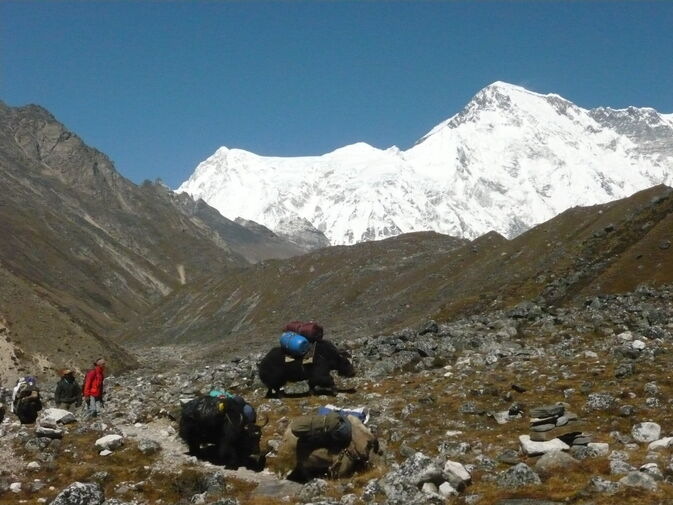
As you round a ridge, the Gokyo Lakes come into view and the reaction from almost every trekker is the same an involuntary stop, and silence. The water is an extraordinary shade of deep turquoise-blue, perfectly framed by the white flanks of Cho Oyu (8,188m) and the surrounding peaks. Gokyo village sits right at the edge of the third and most sacred lake, Dudh Pokhari. Walk along the shoreline, rest, and take in the extraordinary peace of this place. After the intensity of the last several days, Gokyo feels like a reward. Walking time: 3–4 hours.
The signature hike of the entire Gokyo Valley and one of the finest viewpoints in the Khumbu. There is nothing subtle about the climb to Gokyo Ri (5,357m) it goes straight up from the edge of the village, steep from the very first step, for about 2 hours.
At the summit, the view opens up in every direction. Everest (8,848m), Lhotse (8,516m), Makalu (8,485m), and Cho Oyu (8,188m), four of the world’s six highest mountains, are all visible at once. Below you, the Gokyo Lakes shimmer in the high-altitude light and the Ngozumpa Glacier flows south like a slow grey river. Many experienced trekkers and mountaineers consider this panorama the finest in the Khumbu; some say it surpasses even Kala Patthar for the sheer number of peaks on the horizon.
Descend to Gokyo for lunch, spend the afternoon wandering along the upper lakes if energy allows, and rest well for the descent tomorrow.
Leaving Gokyo means leaving behind the high, cold, remote world of the upper Khumbu and beginning the long journey back to Lukla. The trail descends the Gokyo Valley southward through wide open ridges and high pastures, passing through Machhermo and eventually dropping into Dole. As you lose altitude, the air thickens, your legs find a rhythm again, and the landscape slowly softens shrubs return, then small trees, then the rich green of the lower forests begins to appear. Dole is a quiet, welcoming village where trekkers moving in both directions often pause to rest. Walking time: 5–6 hours.
The trail from Dole continues southward along the ridge above the Dudh Koshi Valley, passing through the small settlements of Luza and Lhabarma before dropping into the forests above Namche. As Namche Bazaar comes back into view, there is a quiet sense of satisfaction that you left it 10 days ago heading into the unknown, and you are returning with three passes, two base camps, and a complete Khumbu circuit behind you.
Celebrate with a proper meal, a hot shower if available, and perhaps a coffee at one of Namche’s bakeries. You have earned it. Walking time: 4–5 hours.
The final trekking day. The trail retraces the familiar route southward from Namche down through the forest, across the suspension bridges, along the Dudh Koshi River. The path that felt steep and challenging on Day 3 now flows naturally beneath your feet. You are a completely different trekker from the one who first climbed to Namche.
Arrive in Lukla, check into your teahouse, and spend the evening celebrating with your guide and porter. Share a meal, raise a cup of chang or lemon tea, and thank the people who made this journey possible. Walking time: 6–7 hours.
An early morning flight returns you to Kathmandu. Mountain weather determines departure times in Lukla, so patience and flexibility are always required. Once back in the city, transfer to your hotel, enjoy a long hot shower, and spend the rest of the day as you please exploring UNESCO heritage sites, shopping in Thamel, or simply sitting somewhere warm with good food and letting the mountains settle into memory.
This day is built into the itinerary as a weather buffer for potential delays on the Lukla flight a completely normal occurrence in the high Himalayas. If your flight returns on schedule, you have a full free day in Kathmandu.
Use it well. Visit Pashupatinath Temple, one of the most sacred Hindu temples in the world or sit quietly at Boudhanath Stupa and watch the monks and pilgrims circle the great white dome. The medieval courtyard of Patan Durbar Square is a 20-minute taxi ride and one of the finest examples of Newari architecture anywhere. If you prefer to rest, a spa, a cooking class, or simply a long lunch in a rooftop cafe is equally valid after 15 days in the mountains.
Your 19-day Cho La Pass EBC Trek comes to an end. Our team transfers you to Tribhuvan International Airport for your onward journey. You leave Nepal with stronger legs, a quieter mind, and a set of memories that if past trekkers are any guide, will start feeling like plans before you’ve even landed back home.
Trek Difficulty & Physical Demands
The Cho La Pass EBC Trek is rated strenuous to challenging a significant step up from beginner or moderate treks, and one that demands genuine physical preparation and respect for altitude.
- Altitude: You spend multiple days above 4,500m, reach 5,364m at Everest Base Camp, 5,545m at Kala Patthar, and cross Cho La Pass at 5,420m. Altitude sickness is a real risk that the itinerary is specifically designed to manage through two dedicated acclimatization days.
- Cho La Pass: The most technically demanding section of the entire route. A short glaciated section near the top of the pass requires careful footing and confident use of trekking poles. In autumn and spring the crossing is manageable for well-prepared trekkers. In winter conditions, crampons may be required.
- Daily walking: Expect 4–8 hours of walking per day over rocky, uneven, and sometimes steep terrain. The longest days — Cho La crossing, EBC day, and Kala Patthar day — each involve 7–8 hours of sustained effort.
- Physical fitness: A solid cardiovascular base is essential. Regular hiking with a loaded pack, running, cycling, and stair training for at least 2–3 months before departure gives you the best foundation. Strong legs matter on the descents as much as the climbs.
- Experience: Prior high-altitude trekking experience is a genuine advantage on this route. First-time trekkers with strong fitness can complete it, but the combination of altitude, Cho La’s glaciated terrain, and long consecutive days makes prior experience a significant asset.
- Mental strength: On days like the Cho La crossing or the Kala Patthar pre-dawn climb, mental determination carries you as much as physical fitness. A positive, patient mindset is part of the gear list.
Best Time to Trek: Seasonal Comparison
| Season | Months | Weather | Trail Conditions | Views | Recommended |
|---|---|---|---|---|---|
| Spring | Mar–May | Warm & Stable | Excellent | Excellent | Best |
| Monsoon | Jun–Aug | Wet & Cloudy | Poor / Risky | Poor | Avoid |
| Autumn | Sep–Nov | Cool & Clear | Excellent | Excellent | Best |
| Winter | Dec–Feb | Cold & Dry | Icy on Passes | Good | Experienced Only |
Pro tip: For Cho La Pass specifically, October and early April are the ideal windows. The pass is clear of heavy snow, temperatures are manageable, and the views from both Gokyo Ri and Kala Patthar are at their sharpest. Avoid late November for this route as early snowfall on Cho La can complicate or block the crossing.
Booking Your Chola Pass EBC Trek 19 Days
Booking is simple and we take care of all the logistics so you can focus entirely on preparation.
Step 1 — Contact us. Reach out via our website, email, or WhatsApp with your preferred travel dates and group size. We respond within 24 hours with a detailed itinerary and full cost breakdown.
Step 2 — Confirm your booking. A 20% deposit secures your dates. We immediately begin permit applications and domestic flight bookings upon receiving your deposit.
Step 3 — Prepare. We send you a comprehensive pre-departure guide covering training recommendations, detailed gear lists, altitude sickness awareness, day-by-day expectations, and travel tips for Nepal.
Step 4 — Arrive in Kathmandu. We collect you from the airport, brief you on every aspect of the trek, and help with any last-minute gear needs in Thamel if required.
Step 5 — Trek. Your licensed guide leads you through every day of the route, supported by experienced porters and our full logistical backup. Your safety and experience are our responsibility from start to finish.
Step 6 — Pay the balance. The remaining 80% is due on arrival in Kathmandu before departing for Lukla.
Cancellation Policy:
- 30+ days before departure: Full deposit refunded minus bank transfer charges
- 15–29 days before: 50% refund of deposit
- Less than 15 days before: Deposit forfeited, no refund
Travel Insurance — Mandatory: Travel insurance that explicitly covers emergency helicopter evacuation at altitudes above 5,500m is required for all trekkers on this route. An emergency helicopter rescue from the Khumbu region can cost USD 3,000–6,000 or more. Do not book this trek without proper coverage. We will ask to see your policy details before departing Kathmandu.
Cost Details
Cost Includes
- Airport pick-up and drop-off in Kathmandu
- Kathmandu–Lukla–Kathmandu domestic flights (round trip)
- 2 nights’ hotel accommodation in Kathmandu (bed & breakfast, 3-star)
- All teahouse accommodation during the trek (14 nights)
- All meals during the trek — breakfast, lunch, and dinner
- Experienced, English-speaking, government-licensed trekking guide
- One porter for every two trekkers (max 15 kg per porter load)
- All required trekking permits:
- Sagarmatha National Park Entry Permit
- Khumbu Pasang Lhamu Rural Municipality Permit
- TIMS Card
- Guide and porter wages, meals, accommodation, and insurance
- All government taxes and local charges
- Sleeping bag and duffel bag rental (if needed)
- First Aid Kit carried by guide throughout the trek
- Emergency evacuation arrangement (evacuation cost covered by travel insurance)
Cost Excludes
- Nepal entry visa fee (approx. USD 50 for 30 days — available on arrival at Kathmandu airport)
- International flights to and from Kathmandu
- Travel insurance with emergency helicopter evacuation coverage (mandatory — see Booking section)
- Meals in Kathmandu beyond breakfast
- Hot showers, Wi-Fi, device and battery charging along the trek (charged at teahouses)
- Personal snacks, bottled water, energy drinks, and alcoholic beverages
- Tips and gratuity for guide and porter (recommended and appreciated)
- Personal trekking gear and equipment
- Any extra nights in Kathmandu beyond the planned itinerary
- Helicopter rescue costs (must be covered by your personal travel insurance)
- Personal expenses — laundry, souvenirs, phone calls, and incidentals
Trip Gallery
Trek Essentials
- Thermal base layer top and bottom — 2 sets
- Mid-layer fleece or softshell jacket
- Down jacket or insulated puffy (essential above 4,000m — do not cut corners here)
- Waterproof, windproof hardshell jacket and trousers
- Trekking trousers — 2 to 3 pairs
- Warm trekking socks, wool or synthetic — 4 to 5 pairs
- Thin liner gloves and a warm outer glove or mitten
- Warm beanie or wool hat
- Sun hat or cap with a brim for daytime sun
- Neck gaiter or buff
- Waterproof, ankle-support trekking boots — broken in thoroughly before the trek. This is non-negotiable.
- Lightweight camp sandals or flip-flops for teahouse evenings
- Gaiters — recommended for Cho La Pass; essential in winter or early spring
- Trekking poles — both collapsible, strongly recommended for pass crossings and steep descents
- Daypack (20–25 liters) for daily essentials on the trail
- Duffel bag (60 liters) for your porter to carry
- Sleeping bag rated to -15°C to -20°C
- Headlamp with spare batteries
- Quality sunglasses with UV400 protection — glacier glasses for Cho La Pass days
- Water bottle (1–2 liters) or hydration bladder
- Water purification tablets or a personal filter
- Diamox (acetazolamide) for altitude sickness prevention — consult your doctor before the trek
- Personal first aid kit: blister pads, ibuprofen, bandages, antiseptic cream
- Sunscreen SPF 50+ and SPF lip balm — UV radiation is intense at altitude
- Hand sanitizer and biodegradable wet wipes
- Diarrhea medication and oral rehydration salts
- All personal prescription medications with a full supply for the trip duration
- Valid passport with at least 6 months remaining validity
- Nepal visa (obtainable on arrival at Kathmandu airport)
- Printed travel insurance policy with emergency evacuation details
- 2 passport-sized photos for permit processing
- Emergency contact card kept on your person throughout
Final Thoughts:
The Cho La Pass EBC Trek is one of those rare journeys that gives you everything in a single itinerary the Everest Base Camp experience that has drawn adventurers from around the world for decades, the serene and spectacular beauty of the Gokyo Lakes that most trekkers never see, and the raw, physical satisfaction of crossing a glaciated Himalayan pass at over 5,400m on your own two feet.
It is a trek that asks something genuine from you. Long days, real altitude, and a technical pass crossing require honest preparation and genuine respect for the mountains. But in return, the Khumbu gives you more than views. It gives you a different understanding of your own capability, a deep quiet that is hard to find anywhere else, and a connection to one of the most extraordinary mountain cultures on Earth.
Whatever brings you to this trek, the challenge, the beauty, the bucket list, or simply the call of something bigger than ordinary life, the Cho La Pass EBC Trek will meet you exactly where you are and take you somewhere you didn’t quite expect.
Your Adventure to Annapurna Base Camp Trek Starts Here
Start your journey with trusted local experts and discover the beauty, culture, and adventure waiting in the Himalayas and beyond.
Frequently Asked Questions
Everything you need to know about the AASRA ECO TREK
The standard EBC trek follows a single route to Base Camp and returns the same way. The Cho La Pass EBC Trek adds the crossing of Cho La Pass (5,420m) and the entire Gokyo Valley experience, including the Gokyo Lakes and Gokyo Ri, making it a much more complete and varied circuit through the Khumbu. Instead of retracing your steps, you complete a genuine loop through two of the region’s most spectacular valleys.
It is strongly recommended. While highly fit first-timers have completed this trek, the combination of sustained days above 5,000m, the technical Cho La Pass crossing, and the overall length and difficulty of the route makes prior experience a genuine advantage. If this is your first high-altitude trek, completing the Everest Base Camp Trek or Annapurna Base Camp Trek first is excellent preparation.
In spring and autumn conditions, the Cho La crossing is challenging but safe with a good guide and proper gear. The short glaciated section near the top requires careful footing and the confident use of trekking poles. In winter, the pass can be iced over and crampons become necessary. We always assess weather and conditions before attempting the crossing and will hold at Dzongla if conditions are unsafe.
You need the Sagarmatha National Park Entry Permit, the Khumbu Pasang Lhamu Rural Municipality Permit, and a TIMS Card. All three are included in the package price and arranged on your behalf.
Yes, travel insurance is mandatory. Your policy must cover emergency helicopter evacuation at altitudes above 5,500m and medical treatment in Nepal. A helicopter rescue from the upper Khumbu costs USD 3,000–6,000 or more. Standard travel insurance often does not cover high-altitude activities check your policy specifically and confirm altitude coverage before booking.
Teahouses along the route offer a solid range of local and international dishes, including dal bhat, noodle soups, pasta, porridge, eggs, momo, Tibetan bread, pancakes, and more. Three meals per day are included in the package. Food quality and menu variety are best in Namche and Dingboche, and naturally simpler at the highest elevations. Hot drinks, such as tea, coffee, hot lemon, ginger, are available everywhere and are your best friends above 4,500m.
In spring (March–May) and autumn (September–November) crampons are generally not required. In winter or after fresh snowfall, microspikes or crampons can be necessary for the glaciated section of the pass. We assess conditions in real time and advise accordingly. Your guide will always make the final call based on what is actually on the ground.
Yes. Thamel in Kathmandu has a wide range of trekking gear for both rent and purchase down jackets, sleeping bags, trekking poles, gaiters, crampons, and duffel bags are all readily available at reasonable prices. If you don’t trek regularly, renting is a practical, cost-effective option.
Start training 3 months before departure. Prioritize cardiovascular fitness hiking with a loaded backpack is the single best preparation. Running, cycling, and stair climbing are all effective. Include strength training for legs and core. Practice walking downhill with weight, which is harder on the knees than climbing. Aim for at least one multi-day hike before arriving in Nepal.
Absolutely. We can slow the pace with additional rest days, adjust overnight stops, add an extension to Chhukung Ri (5,550m) for even more spectacular views, or arrange a helicopter return from Gorakshep if you prefer not to walk back to Lukla. We can also extend the itinerary to include Renjo La Pass and complete the full Everest Three Passes circuit. Contact us and we will build the right version for your group, schedule, and fitness level.